Winter 2026 issue of Speckle Park Insider out now
The Winter 2026 edition of Speckle Park Insider is now available online bringing together a diverse collection of stories showing how Speckle Park is progressing across the industry, from commercial herds and beef on dairy programs to processor supply chains, premium branded beef, breed development and member led initiatives.
A strong commercial thread runs throughout the issue, highlighting the growing value of measurable performance, reliable data and closer connections between breeders, producers, processors and customers, while celebrating the people and programs helping shape the breed’s future.
Livestock consultant and stock agent Andrew Hosken provides a direct assessment of the breed from years of experience moving cattle through saleyards, feedlots and processing programs. Drawing on kill sheets and MSA results from thousands of cattle across multiple seasons, he explains why producers need to look beyond appearance and understand the market they are targeting.
Andrew has consistently seen strong MSA grading outcomes in Speckle Park infused cattle, including across yearling and cow groups. He also points to the breed’s ability to hold condition, forage effectively and perform across a range of crossbreeding systems.
His message is straightforward. The paddock and the rail do not always tell the same story, and producers should judge cattle on what they deliver through the full production chain.
That commercial focus continues through the story of Arley Farms in Western Australia. Ben and Victoria Murphy have moved beyond breeding and selling cattle to build a direct supply chain for Speckle Park beef.
Arley now breeds, finishes and processes cattle for butcher shops and premium foodservice customers, including Olsen Butchers and Nextdoor restaurant. Across 119 Speckle Park infused cattle processed in 2026, the business recorded an average MSA Index of 62.46, with 86 per cent grading above the national top quarter threshold.
The results demonstrate what can be achieved when genetics, finishing, processing and customer relationships are connected through one clear system.
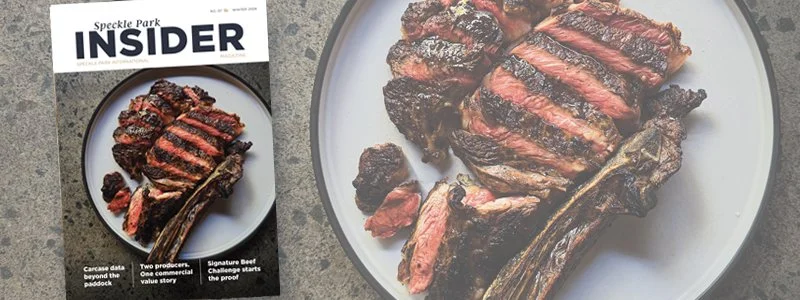
Speckle Park Insider - Winter 2026
In South Australia, Graeme and Amanda Kroehn of Belgrae are following a different pathway, supplying grass fed Speckle Park infused cattle into the Greenham and Woolworths supply chain.
Their cattle are reaching market specifications at a young age while delivering consistent MSA outcomes. Processor feedback is helping the Kroehns refine their breeding and management decisions, providing hard data to support what they have already observed on farm, including strong growth, feed conversion, temperament and carcase performance.
The issue also looks at how Speckle Park genetics are creating value beyond traditional beef herds.
At Dairy Adventures, Narelle Zanker is using Speckle Park sires over dairy cows to produce calves with greater shape, growth and commercial value. The program is helping turn calves not required as dairy replacements into a developing beef enterprise, with cattle being finished to more than 600 kilograms for an MSA market.
For dairy producers considering beef on dairy, the story offers practical insight into calving ease, temperament, growth, carcase quality and the importance of maintaining records from birth through to processing.
At Chalambra in Victoria, Simon and Alex Menzel are building Speckle Park genetics into a flexible, self replacing commercial herd. Running Speckle Park and Angus based females under the same seasonal conditions has given them a clear comparison.
The Menzels report that their Speckle Park cows have required less feed, maintained condition more effectively and achieved strong conception rates through difficult seasons. For their business, the commercial case is being built around efficiency, carrying capacity and lifetime productivity.
The edition also crosses the Tasman to examine the continued growth of SpeckleBeef. The branded program secured Gold for both Sirloin and Scotch at the New Zealand Food Producer Awards, backing up its success from the previous year.
More importantly, the program is using camera grading, carcase feedback and eating quality data to build consistency at commercial scale. With plans to grow significantly over the coming years, SpeckleBeef provides a strong example of what can be achieved when genetics, producer relationships, processing data and a clear brand proposition are connected.
Alongside these producer stories, the Winter issue explores how the Speckle Park Commercial Register can help capture carcase data, strengthen contemporary groups and improve EBV accuracy. It also provides a practical guide to Meat Standards Australia and introduces the Speckle Park Signature Beef Challenge, which will create another platform to benchmark eating quality across purebred and Speckle Park infused cattle.
The magazine also shares SPI organisational and breed development updates, youth and member events, and industry insights that reflect the breadth of activity taking place across the Speckle Park community.
Together, these stories show a breed building stronger evidence, clearer market pathways and deeper connections between breeders, commercial producers, processors, butchers, chefs and consumers.
For anyone interested in the commercial direction and continuing development of Speckle Park, this is a must read edition.
Read the Winter 2026 issue of Speckle Park Insider now
SPI remains committed to delivering relevant, practical and forward-looking content for members, commercial producers and industry stakeholders.
For editorial enquiries or advertising opportunities in future editions, contact communications@specklepark.org
