Commercial Register (SPCR): measure it, prove it and use it.
What is the SPCR?
The SPCR is SPI’s pathway for recording performance data on commercial steers and heifers, helping producers capture genetic gain and make more confident breeding decisions within their own herd.
It is not a seedstock register and it is not designed for breed-up or stud registration. Those functions remain with the Speckle Park Purebred Register (SPPR).
Speckle Park Commercial Register (SPCR)
Built to protect the herdbook
Built on two core principles of protecting the integrity of SPI’s herdbook and ensuring accurate, reliable data collection.
These principles underpin the rules and limitations that apply to the SPCR register.
Turn day-to-day paddock performance into something you can use, prove and profit from.
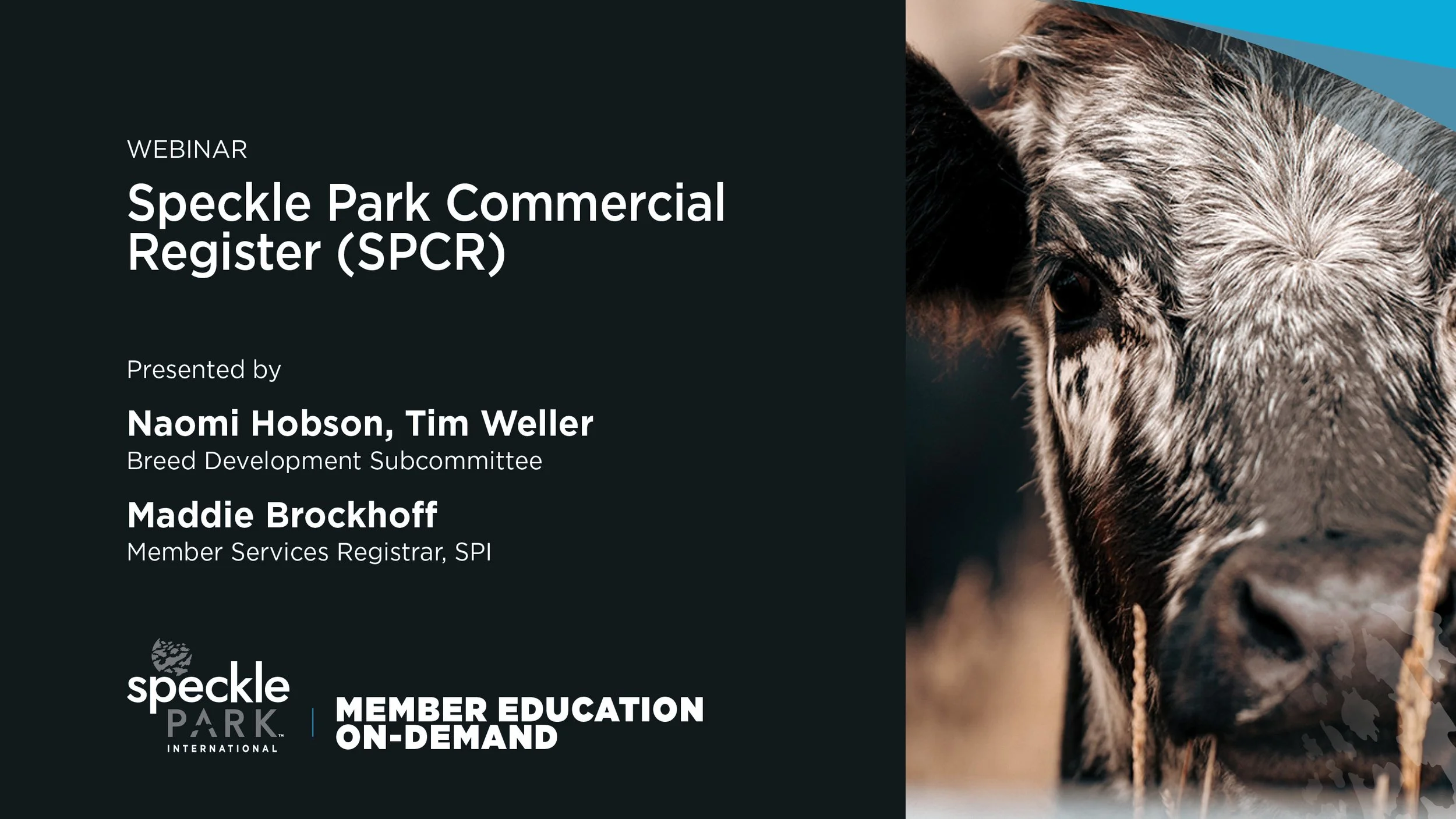
WEBINAR ON-DEMAND VIDEO
Learn more about the Speckle Park Commercial Register as Tim Weller, Naomi Hobson and Maddie Brockhoff explain its purpose, benefits and the process for submitting data through the SPI form.
Who can use it and what you can record
The SPCR is open to SPI members and provides a valuable tool for commercial Speckle Park producers to record performance traits for steers and heifers, identify superior-performing females, make more informed breeding and culling decisions, target specific market requirements, support traceability and verified supply chains and help build and strengthen our genomic reference population.
Animals recorded in the SPCR can be provided with verification documents, and there is potential to develop a verified ear tag identification system aligned with commercial market or processor requirements.
Only steers and heifers may be recorded in the SPCR. SPCR-registered animals fall into one of two categories:
Progeny of a SPPR female either registered in the SPPR herdbook or the SPCR, or
Progeny of a “base” female (commercial cow) mated to a registered SPPR bull.
Important restriction: No entire males (bulls) may be registered in the SPCR.
How it helps you sell cattle and hit specs
By collecting and submitting performance data through the SPCR, producers gain access to tools and information that can significantly enhance the marketability of their cattle.
Additionally, it continues to build the genomic reference population to advance the accuracy of Speckle Park EBVs.
Below are specific examples of how SPCR data can support herd marketing:
-
Producers can use SPCR records to confidently promote animals based on objective traits such as:
Weight gain performance (e.g. “This steer achieved 2.2 kg/day average daily gain over 100 days.”)
Carcase traits linked to EBV or sire/pedigree performance (e.g. eye muscle area, IMF)
Maternal performance indicators (e.g. age to first calving, weaning weights)
This can be particularly powerful in direct-to-consumer marketing or paddock-to-plate programs.
-
Data collected through the SPCR can be used to target specific markets or processor specifications, such as:
MSA grading compliance
Feedlot entry specs (weight-for-age benchmarks, temperament traits)
Branded beef programs that require verifiable breed content or production protocols (e.g. pasture-raised, no HGP)
By using SPCR animals with performance history and traceability, producers can supply processors or brands requiring documented assurance.
-
When selling steers or future commercial breeders, producers can present SPCR performance data as added value:
“Progeny of proven SPPR sires with documented daily gain and dam fertility records.”
“SPCR-enrolled heifers with full ID, known genetics, and maternal productivity data.”
This gives buyers confidence and can justify premium pricing, especially in breeder, backgrounder, and bullock production systems.
-
SPI is currently exploring the development of a verified ear tag identification system for SPCR animals. This system will align with commercial supply chain needs and may include:
QR code or unique visual tags linking to SPCR data
Verified parentage or breed makeup
Market specification tags (e.g. grain-free, grass-fed, no antibiotics)
Once implemented, this system will further support:
Paddock-to-plate traceability
Retail/lot feed contract compliance
Buyer trust and data transparency
What you need to register animals
SPCR animals (progeny)
To register an animal in the SPCR, the following six information must be provided.
Unique ID (e.g., ABC V123)
NLIS / NAIT or EID tag number, with PIC number
Birth date (DD/MM/YY)
Sire and Dam information (at least one parent must be a registered SPPR animal)
Breed composition (eight digit breed code Speckle Park – SKSKSKSK)
DNA parent verification and genetic profile (optional but recommended)
NLIS/EID data is required for any animals being submitted, to enable future linkage with Meat Standards Australia (MSA) carcase data.
Need help?
If you have questions about eligibility or how to submit SPCR registrations, please contact SPI for support.
Moving between SPCR and SPPR (rules and DNA)
This is not a mechanism to breed up into the SPPR. If a breeder wishes to later register SPCR progeny in the SPPR, they must follow the full registration rules and fees for every previous generation not in the SPPR.
SPPR females can be marked as “Inactive” and moved into the SPCR, but if there is to be any future registration of descendants into the SPPR is advised that DNA to be taken and stored at the time of SPCR registration.
SPI reserves the right to conduct random DNA parentage verification on SPCR animals.
-
While the Speckle Park Commercial Register (SPCR) is not designed to produce seedstock animals, breeders can apply to register progeny from the SPCR back into the Speckle Park Purebred Register (SPPR) but only if the animal traces back to an original SPPR-registered female. Conditions do apply to ensure the integrity of the SPPR herdbook.
-
The animal must trace back to a SPP-registered female (even if that female is now marked Inactive and in the SPCR)
The breeder must complete full DNA parent verification and registration for every generation not currently recorded in the SPPR
All registration, late, female inventory and DNA fees must be paid for each animal in the lineage
Complete pedigree documentation must be submitted
There is no generational shortcut. Every step in the animal’s pedigree must be proven and documented to re-enter the SPPR.
-
Let’s say a breeder has the following lineage:
SPPR Dam
Originally registered in the SPPR, later made Inactive and transferred to SPCR.SPCR Heifer 1
Calf of the SPPR dam, sired by an SPPR sire – identified in the SPCR.SPCR Heifer 2
Calf of SPCR Heifer 1, again sired by an SPPR sire – also in the SPCR.SPC Heifer 3
Calf of SPCR Heifer 2, also sired by an SPPR sire. The breeder now wants to register this calf in the SPPR.
To do so, they must provide DNA verification and registration for all three generations (SPCR Heifer 3, 2, 1). Prove the maternal line traces to a genuine SPPR female via DNA PV and pay all associated fees and complete all required documentation. Only then will SPCR Heifer 3 be considered for entry into the SPPR register.
This rigorous process:
Prevents dilution of the SPPR studbook
Preserves breed data accuracy
Encourages transparent and traceable breeding practices
Getting started + fees
To participate in the Speckle Park Commercial Register (SPCR), you must be a current financial member of Speckle Park International (SPI). All SPI fees listed below are inclusive of GST. Membership details and pricing are available in the SPI Membership Form.
Fees and charges (SPI fees)
Fees for SPCR participation are set out in the SPI fee schedule. They are designed to support practical data submission while keeping the register affordable.
SPI membership: current financial membership required.
SPCR animal processing fee: $10 per animal.
Note: female inventory fees do not apply to SPCR-registered heifers.
Transfers and DNA (as required): $27.50 per animal to transfer between members, plus optional DNA testing bundles (required if transferring from SPCR to the Speckle Park Purebred Register (SPPR)). Refer to SPI Fee Schedule for more information.
Other costs (charged separately by BREEDPLAN)
BREEDPLAN (ABRI) fees are separate to SPI and are set and billed directly to you by BREEDPLAN.
BREEDPLAN membership and processing fees: charged as per the Speckle Park BREEDPLAN Fee Schedule (click here for details).
GST: International clients are not charged GST where applicable.
The register lets commercial producers contribute real performance data that strengthens Speckle Park genetics while protecting the integrity of the herdbook. It supports sharper herd decisions, stronger traceability and greater industry confidence.